Never I have come back from a location with such mixed emotions. The tibetan people are lovely
Take your pick of words to describe the plight the Tibetan people find themselves, bollocks,
Expecting a police state, you are still taken aback by the sheer presence of the police and military patrolling the streets and countryside only to be gob smacked by stories of triple the numbers only a few weeks earlier prior opening the borders for tourists. A five minute walk quickly encounters up to 40 police with five per corner and patrolling in fives packed with guns, broom sized batons, and knife sticks. On our trip, which we get to shortly, we drove past one convoy of 60 odd police trucks and a second with 36.
Only the most naive, and we met one on the train ride home, would think believe that they are making the lives of ordinary Tibetans better.
The Tibetans, living up to their friendly reputation, do not seem to take umbrage at the Hans as a people, only their corrupt and oppressive communist government. For me, it is hard not to feel angry at the han, a people who have only attempts to keep their government under country, is to find another corrupt tyrant(s) to take over.
Religion, politics, public servants, and all manner of security forces have power and they all contain examples of the worst people in history. Perhaps this is why people started anarchism? Anyway, back to the point. I expected more from bhudhist faith. I really, really, really wanted to meet peaceful, insightly, and genorours people and just hate the communist party.... It didn't happen.
For starters, there was no utopian society before the Chinese whatever a unwashed hypocritical hippy will tell you, these people lived in a fuedal society, basically slaves to the landed gentry and the monks.
I have no issues with not taking photo's in religious or sacred sights and having limited restrictions like Potala palace, but enough monastaries did not use either of these.
Not knowing much of anarchist philosophy, but I wonder if this is a good reason to believe. I don't know why, but for some reason, you expect more from buhdhist monk? Is is the Dali Lama, the apparent lack of a checkered past, or these airy fairy bhudhist in Australia bitching about free Tibet, but lacking the same compassion for other oppressed people?
Monday, 25 May 2009

Wednesday, 29 April 2009
A little bit of sunshine and party town

To paraphrase the foreign minister of Vietnam during the war in his conversation with Robert McNamara years later...
We were not pawns of the Chinese, we have been fighting them for a thousand years. We were fighting for our independence
If you wake up and find yourself living just outside a great expansive empire, be sure not to blink, or you'll quickly find yourself a part of it. China has officially 56 minorities with most living on the outskirts of the current incarnation. For these people, their unfortunate location has lead to a history full of conflict, whether fighting an aggressor or being in the middle of two enormous warring states. Maintaining their unique culture, customs, heritage, personality, and identity identity is a task not sneezed at.
The Naxi, centered around Lijang in the Yunnan province, are a quiet and pleasant people, for which, you wonder whether is a product of their beautiful and peaceful surrounds or in deference to the majority. With the persecution of the cultural revolution thankfully over, they find themselves in a strange new world, where tourists actually pay to see their culture and custom, albeit in that sickly sweet touristy way. Their clothing is both beautiful and intricate, albeit somewhat over utilised for the Han held cameras. The magnificent of the three pagoda's and their seemingly never ending array of temples is only matched by the enormity of the ticket price. The idyllic surrounds have seen many an expat setup shop or life to take advantage of the heavenly location. Although our time was short in both Dali and Lijang, it is clear that this is a must see place, but only in off season. The hordes of tourist is almost overbearing in Lijang and would become torturous in the height of summer.
Lounging about in the awesome hump hostel in Kunming, you quickly understand why this is (young) backpacker heaven. Great whether, good diversity of food, plenty of ex pats and backpackers fresh from Vietnam and Laos, and a night scene that encourages the excesses of the western backpacker produce many weary souls. For us, we unwound and of course had a few drinks whilst we arrange our onward tickets.
Wednesday, 8 April 2009
Go the underdog and one giant bhudda.
You save the things you love, and you love the things you understand

When the sun shines on you in China, life is almost perfect. Take the endemic Giant panda as an example, almost hunted to extinction before it captured the adoring attention of the world, thus changing it's fortune for ever. From all the available information, the Chengdu Research Base of Giant Panda Breeding is a seriously world class facility, where previously captive animals live in a well maintained and humane environment, and with any luck, get down to the business of saving the species. Of course, this being China, money talks, and their facility and probably survival is predicated on every bus load of han, korean, and Japanese tourists and the wealth it creates. Sure, some of the treatment in lieu of capturing a ooh and aah from a gushing tourist is midly questionable, and yes, count me as one of them, but compared to others, the Panda's have it made. And what makes me really happy after seeing these big fur balls of fun, is the underdog of underdogs, the forgotten red pandas who are riding the coat tails of their richer cousins to survival. 
The province of Sichuan, home of the Sichuan beef you'll pick up at your local Chinese takeaway, has some seriously good and spicy grub. Their famous hotpot, a steamboat with a potent mix of chilli (and lots of it), soy, water and a variety of sauces to cook a variety of meats and vegetables is outstanding.
Chendgu, like any major city in China is seriously polluted, but like all Chinese cities visited thus far, the serenity and peace of a temple, garden, former palace are generally only a short distance away. Strolling the grounds of the Wuhou temple, infact a serious of temples mixed with gardens, ponds, and monuments is welcome escape from the noise, concrete, and neon of the bustling city that is Chengdu. It is almost otherworldly as you pass from one bueatiful scene to the next and the only noises are from the rustling of the leaves, birds, and the movement of water through ponds and moats.
It what is a centuries old pastime, we sat for an afternoon drinking tea and playing cards in the grounds of the Wuhou temple with the local denziens discussing business and gossiping over a bowl of nuts or a game of cards or majong.
Visiting leshan one our way back from Emei Shan, we checked out the impressive Leshan Giant Buddha, the the worlds largest at a lofty 71 metres. The ensuing journey home was memorable for its varied and timely transportation, taking 8 hours from emei shan to home, via a cable car, 5 busses, and two taxi's.
Emei Shan and marrauding macaques
Only being two hours south of Chengdu, Emei Shan, one of China's four holiest bhudist mountains and a world heritage unesco site, was a hiking opportunity not to be missed. Lodging at the foot of the mountain, albeit conned into staying at the wrong hotel, we enjoyed the manufactured, but tasteful serenity of the small tourist town of Baguo. I imagine years of experience with propaganda has made construction of these usualy dreary places quite easy? It must be noted, that with sizable bhudist populations in China, Korea, and Japan, these bhudist sites are often full, if not saturated with snap happy tourists who somehow don't see the irony in catching busses and cable cars instead of undertaking the time honoured pilgrammage and hiking up the mountain.
With an early start, we catch a mini bus up the mountain and begin our hike at 7:40, bypassing the first cable car, utilsed by all bar a few dedicated locals. It becomes quickly apparent that this park has been indentified as a tourism goldmine and a troupe of dedicated, albeit relaxed staff duitifully maintain the park and path leading up the mountain. The ascent, all 2000 metres of it, features dozens of monastaries and temples and is well served by a proper stair case numerous snack stops and the odd restaurant, all seemingly in danger of falling of the mountain.
After 7 hours of hiking, we estimate 18000 stairs, and sacrificing my water bottle to a marraunding macaque, we reach the last monastary and the cable car to ascend the last 300 metres. Let me you, the misery was palpable, drizzle, wind, snow slush over the paths and not even enough degrees C to fill up one hand. Our tired, tired, tired legs wear screaming "Tomorrow, tomorrow". Our new found friends on the other hand, a bunch of 20 something university students, not carrying 10 kilo packs, were not. Seemingly dragged onto the cable car, we drearily pass through the misery and clouds to reach.... blue skies and sunshine?!?!?! It must be 20 degrees and the view, the bluest of skies over white dreamy clounds. UN - BE - LEIVE - ABLE!!!!! This is not what we were expecting, our guidebook is preaching an average maximum of 2 degrees and the view requiring nothing more than devine intervention. We quickly explore the snow covered mountain top and discover sculptured elephant statues leading us up the staircase to a 50 odd metre golden budha and a number of ancient temples. , oh and did I mention the view?

Splurging on possibly the greatest $80 room on the planet, we forgo the pleasure of bunking in a uninsulated monastary, for hot showers, central heating, and warm noodles. The next day and another 5:45 am wakeup call, we set out for the sunrise, which is apparently even better, but are hampered by visibility of less 100 metres. It must be said, after the previous day, we are certainly not dissapointed as we have truly witnessed something special and even spare a moment to pity the snap happy tourists who bus all but 2 kilomtetres (and complain) and miss this view.
Plagued by timing problems, we skip the downward hike and travel 8 hours by 6 busses, 1 cable car, and 1 taxi back to Chengdu.
With an early start, we catch a mini bus up the mountain and begin our hike at 7:40, bypassing the first cable car, utilsed by all bar a few dedicated locals. It becomes quickly apparent that this park has been indentified as a tourism goldmine and a troupe of dedicated, albeit relaxed staff duitifully maintain the park and path leading up the mountain. The ascent, all 2000 metres of it, features dozens of monastaries and temples and is well served by a proper stair case numerous snack stops and the odd restaurant, all seemingly in danger of falling of the mountain.
After 7 hours of hiking, we estimate 18000 stairs, and sacrificing my water bottle to a marraunding macaque, we reach the last monastary and the cable car to ascend the last 300 metres. Let me you, the misery was palpable, drizzle, wind, snow slush over the paths and not even enough degrees C to fill up one hand. Our tired, tired, tired legs wear screaming "Tomorrow, tomorrow". Our new found friends on the other hand, a bunch of 20 something university students, not carrying 10 kilo packs, were not. Seemingly dragged onto the cable car, we drearily pass through the misery and clouds to reach.... blue skies and sunshine?!?!?! It must be 20 degrees and the view, the bluest of skies over white dreamy clounds. UN - BE - LEIVE - ABLE!!!!! This is not what we were expecting, our guidebook is preaching an average maximum of 2 degrees and the view requiring nothing more than devine intervention. We quickly explore the snow covered mountain top and discover sculptured elephant statues leading us up the staircase to a 50 odd metre golden budha and a number of ancient temples. , oh and did I mention the view?

Our legs silenced, we marvel upon our fortune and start to wonder, what poor bastards a) lifted all this up the mountain and b) built these fantastic structures hundreds of years ago.
Splurging on possibly the greatest $80 room on the planet, we forgo the pleasure of bunking in a uninsulated monastary, for hot showers, central heating, and warm noodles. The next day and another 5:45 am wakeup call, we set out for the sunrise, which is apparently even better, but are hampered by visibility of less 100 metres. It must be said, after the previous day, we are certainly not dissapointed as we have truly witnessed something special and even spare a moment to pity the snap happy tourists who bus all but 2 kilomtetres (and complain) and miss this view.
Plagued by timing problems, we skip the downward hike and travel 8 hours by 6 busses, 1 cable car, and 1 taxi back to Chengdu.
Tuesday, 31 March 2009
City walls, people watching, and a city that has something
The soft sleeper, although packing the matress of your grandma's couch, was the perfect fit at 6'4 lad and an ideal way to travel from Shanghai to Xi'an. For sure, we were a curiosity and a surprise to the guards and locals, but the gawks and giggles are easily humoured or ignored. Gazing out the windows, you quickly notice bare or unutilised land is a rarity; Crops are sown side by side with bridges, roads, and telephone poles. Time without a factory appearing on the horizon seems like only minutes and the word cul de sac brings new meaning, when you see 30 identical highrise apartments in a row, housing possibly ten thousand people.
Xi'an as a destination, has it. An ancient city, housing the imperial capitails for nigh on700 years, it is full of history, architectural delights and wonders. Situated in the mid east of China, it is far enough away from the megatropolises of Shanghai and Hong Kong to retain some of it's Chineseness; albeit the mix of 20th century charm, markets, and minority culture versus the neon lights and sky scrapers, and shopping malls of the 21st. The retention of the smaller city walls, 40 metres high covering 13 square kilometres, adds a real authenticity that sometimes you feel is faked for tourists. The hui muslim minority add an interesting mix with unique food, dress, music, architecture, and more kebabs than you can poke a stick at. The local sweets, less sugar intensive than western standards are brilliant at 20c a pop。As a rule, most street food is fantastic, but let me teach you a lesson Children, eating goose feet are why we invented antibiotics. Being smart ars*s, we've taken to communicating in spanish with each other when bartering, this is, until one young attendents snapped "Cuarenta es loco" and game was almost hers, 'cept that I have my Dad's dutch bartering genes.
Engaging the services of a local guide, whose self proclaimed English name is Tiger King (no, not something I made up after a few drinks), we embarked on quick jaunt around the eastern sites in his spanking new SUV. First of, the terracotta warriors, a series of underground "pits" containing at least 8000 unique 6 foot warriors, 130 chariots, 520 horses, and 150 cavarly horses, all masterfully and uniquely sculptured, painted, holding weapons. Built in 210 BC for the first emperor as protection in the after life seemed like a good idea at the time, except he failed to ensure they were adequately protected in the current life. As per most commissioners of great work, he was a bit of a tool who didn't mind engaging in the odd war, rape and pillage, and using slaves, to well, build thousands upon thousands of masterpieces, then killing them to ensure their secrecy. As such, about ten years after his passing, his enemies conquered his kingdom and plundered his tomb leaving a decades of restauration work for today's chinese.
Xi'an as a destination, has it. An ancient city, housing the imperial capitails for nigh on700 years, it is full of history, architectural delights and wonders. Situated in the mid east of China, it is far enough away from the megatropolises of Shanghai and Hong Kong to retain some of it's Chineseness; albeit the mix of 20th century charm, markets, and minority culture versus the neon lights and sky scrapers, and shopping malls of the 21st. The retention of the smaller city walls, 40 metres high covering 13 square kilometres, adds a real authenticity that sometimes you feel is faked for tourists. The hui muslim minority add an interesting mix with unique food, dress, music, architecture, and more kebabs than you can poke a stick at. The local sweets, less sugar intensive than western standards are brilliant at 20c a pop。As a rule, most street food is fantastic, but let me teach you a lesson Children, eating goose feet are why we invented antibiotics. Being smart ars*s, we've taken to communicating in spanish with each other when bartering, this is, until one young attendents snapped "Cuarenta es loco" and game was almost hers, 'cept that I have my Dad's dutch bartering genes.
Engaging the services of a local guide, whose self proclaimed English name is Tiger King (no, not something I made up after a few drinks), we embarked on quick jaunt around the eastern sites in his spanking new SUV. First of, the terracotta warriors, a series of underground "pits" containing at least 8000 unique 6 foot warriors, 130 chariots, 520 horses, and 150 cavarly horses, all masterfully and uniquely sculptured, painted, holding weapons. Built in 210 BC for the first emperor as protection in the after life seemed like a good idea at the time, except he failed to ensure they were adequately protected in the current life. As per most commissioners of great work, he was a bit of a tool who didn't mind engaging in the odd war, rape and pillage, and using slaves, to well, build thousands upon thousands of masterpieces, then killing them to ensure their secrecy. As such, about ten years after his passing, his enemies conquered his kingdom and plundered his tomb leaving a decades of restauration work for today's chinese.

Let me tell you, the Big Goose Pagoda is a real treat. Fortuitiously arriving just before closing time, we virtually had the whole place to ourselves for sunset, bar the odd farting monk. Fantastic architecture, brilliant gardens, and a plethora of bueatiful paintings and sculputres.

Mount Hua, one China's sacred and national mountains, with temples, shrines, and pagodas atop of scenic peaks is lauded about throughout China resulting in about a thousand tourist each day and night; oh, and it is known as the steep one to the locals. Sound brilliant? Well yes, but I accidently booked a tourist bus for Chinese who intended to bypass the hardest sections by cable car, meander up the mountains, and had no intention of letting me go it alone. Now, I'm not sure weather it was my chinglish debating skills or my constant pestering, but I secured my freedom which resulted in one of my most one day memorable hikes. Part adrenalin, part defiance at besting the lazy bunch, part iPod, and part orios, I quickly slayed the additional 2000 metres ascent a passed my group to ascend the first peak treated to a very light snow fall. Adding further to the delight with each peak was either a temple, statue, pagoda, or monastry. I wonder if it will get to me in five weeks, but I was asked to pose in about 10 photo's and even a small group offering to guide me through the passes just because I was a tall westerner.
We sped of to Chengdu on a 17 hour train ridem, befriending a pair of locals, a 17 from near Urumqi and a 24 ex army dude with 2 girlfriends who we chinglished with.
Monday, 30 March 2009
Dumplings, smog, and progress?
You can't talk about Shanghai with a little history lesson. Basically a backwater until the 1830's, when a bit of old fashioned imperialism "allowed" the french and british to set up "concessoions" (read colonies) in the heart of shanghai, complete with their own juristinctions, police forces, taxation systems, even water companies. Firstly, it turned Shanghai into the new york or paris of the orient, a place to be, visited by the likes of albert einstein and u.s. presidents. Secondly, and predictably, with three juristictions, it became a haven of crinimals and prostitues, where evading the police, became simply a matter of crossing the border, earning it the moniker, the whore of the orient. Finally, it made the chinese second class citizens in their own country, which inevitably sows the seeds of discontent.
What happened next is history, the communists formented a revolution, tearing down any vestiges of capitalism, only to reverse course in 1990.
So, what is Shanghai today?
A sprawling megatropolis of 17 million with ubiquitous construction and smog, where a new york type skyscraper can neighbour urban squalor with squat toilets, yellow water, and less than basic hygene. The urban elite buy the wares of street vendors making less than 5 dollars a day, without any sign of discontent. Mao, a man seemingly revered in China for his socialist spirit surely would turn in his grave viewing the inequality that is Shanghia.
It boast a stunning water front "the Bund" with an array of 1880's - 1930's New York and Londonesque buildings inhabit by the party apparatik.
A french concession, filled with potentially romatic relics of yesteryear with numerous fine french dining opportunities.
Wonderous, simply wonderous street vendors line the street offering dumplings, asian styled pancakes, milkshares, and numerous other tasty and "unknown" treats.
If you can picture a 1920's Chinese city, it will be old town, with the typical asian architecture you expect to see on tv. Of course, it is lined with vendors peddling anything from tea, to t-shirts, to the little red book. A quick walk around the corner reveals the urban squalor that you come to expect, but rarely a snap happy tourist would see.
And what of the Shanghaiese? For a large metropolis, they seem a happy enough bunch, albeit a bit pushy when the mere mention of an orderly line. Odly, the salesmen and women aren't pushy by contempary standards. Oh, and they certainly do like to huck a loogee, yes, even the chicks.
Finally, can't forget to mention the remarkable digs Florian put up for us, even whilst he was sunning himself in Cambodia, leaving lock, stock, and barrell to us!
I was the unfortunate diner, after ordering a tasty turtle, only have the waiter explain they were out... Oh the nerve.
All in all, even though I could certainly live and work in Shanghai, I'm not entirely sure it has a soul? Perhaps it was lost during the revolution or push for modernisation, it is sort of like a room with too many colours that don't match. Sure, you like some, but together, they look rather odd.
Next, a 17 hour trip by train to Xian.
What happened next is history, the communists formented a revolution, tearing down any vestiges of capitalism, only to reverse course in 1990.
So, what is Shanghai today?
A sprawling megatropolis of 17 million with ubiquitous construction and smog, where a new york type skyscraper can neighbour urban squalor with squat toilets, yellow water, and less than basic hygene. The urban elite buy the wares of street vendors making less than 5 dollars a day, without any sign of discontent. Mao, a man seemingly revered in China for his socialist spirit surely would turn in his grave viewing the inequality that is Shanghia.
It boast a stunning water front "the Bund" with an array of 1880's - 1930's New York and Londonesque buildings inhabit by the party apparatik.
A french concession, filled with potentially romatic relics of yesteryear with numerous fine french dining opportunities.
Wonderous, simply wonderous street vendors line the street offering dumplings, asian styled pancakes, milkshares, and numerous other tasty and "unknown" treats.
If you can picture a 1920's Chinese city, it will be old town, with the typical asian architecture you expect to see on tv. Of course, it is lined with vendors peddling anything from tea, to t-shirts, to the little red book. A quick walk around the corner reveals the urban squalor that you come to expect, but rarely a snap happy tourist would see.
And what of the Shanghaiese? For a large metropolis, they seem a happy enough bunch, albeit a bit pushy when the mere mention of an orderly line. Odly, the salesmen and women aren't pushy by contempary standards. Oh, and they certainly do like to huck a loogee, yes, even the chicks.
Finally, can't forget to mention the remarkable digs Florian put up for us, even whilst he was sunning himself in Cambodia, leaving lock, stock, and barrell to us!
I was the unfortunate diner, after ordering a tasty turtle, only have the waiter explain they were out... Oh the nerve.
All in all, even though I could certainly live and work in Shanghai, I'm not entirely sure it has a soul? Perhaps it was lost during the revolution or push for modernisation, it is sort of like a room with too many colours that don't match. Sure, you like some, but together, they look rather odd.
Next, a 17 hour trip by train to Xian.
Tuesday, 24 March 2009
Ready, steady, go
The rucksack is packed, but not full. A little nervous about the hour between landing in Sydney, hopefully on time, and the rush to the international terminal. At Shanghai, an hour taxi ride will land us in an apartment of a traveling mate, who just happens to be traveling in Cambodia. We just hope his flat mate is cool and not put out by a pair of stinky backpackers.
Let's go.
Let's go.
Sunday, 22 March 2009
In search of the giant panda
Three more sleeps till the next trip.... 5 1/2 weeks in china, starting in shanghai and ending in bejing. No real plans to speak of, although a desire to head to Tibet. Gatronomically, looking to seriously punish my stomach and spend a night or two nights on some fermented yaks milk. Looking to visit as many minorities as possible, which may lead to a trip to central asia or mongolia. Hopefully the short course in Mandarin this year will help determine what animal Beth is eating. Oh yeah, If I can scare my mum with my exploits, it will probably help me feel young.
Let's do it, China '09.
Let's do it, China '09.
Wednesday, 5 March 2008
We are the little people, the grand adventure, and home sweet home
Who knows when our feet will travel these majestic roads of South America? Hang on a minute, let's just take of the rose coloured glasses before we get carried away... The roads are anything but majestic, and altought they are laden with pot holes, dirty and dusty roads, dodgy dodgy buses and the odd street vendor make the experience Brilliant as brilliant can be.
Firstly wandering the roads of the andies, we discovered natural beuaty of dreams (wanky)with a rich tapestry of cultures (even more so) often stubborningly surviving the columbian inlfux. The blister inducing ten hour hikes of patagonia produced the panoramic landscapes that are today cheesified in motivational posters adoring office walls. Finally, I'm suprised Argentina and Chile have not become a 7th and 8th state. Ice cold beer, massive massive steaks, fun loving locals, architecture of th 19th century, and a party seen that only get's going at 2am, every aussie, rich or poor, priness or pov, conservative or socialist will find something in these magnificient countries.
Call me whinger, call me selfish, but three and half months over these astounding five countries did not enable the following journeys
- Bariloche (and blue lake kyaking) - Oops, booked the wrong flight
- Nazca Plains
- Benard o'higgins parque nacional
- Tierra del fuego
- Antartica
- Jungles of boliva
- Iguazu falls
- Atacama desert
- Salt flats of boliva
Highlights
- Chinese Hong Kong
- The people of Eijsden
- The alhambra and Granada
- Galapagas Islands
- Inca trail (touristy version)
- Machu Pichu
- El Chalten (Where are though Belinda Carlise)
- The brutal Torres del Paine W circuit - even costing an arm and a leg to camp
- Buenos Aires - Continuing the theme of sounding wanky - Shoutouts to Blue and Ryan
- Every creature great and small that venture to close to the local butcher, and ended up on the plate
An awesome trip should not end, let alone with a 26 hour stop at the truly forgetable and magnificently expensive Tahiti. Shacked up at $40 per person per night hostel (cheapest in town) in an 10 bed room with no sheets is truly John Elliot. Perhaps the single worst museum of world is the papeete Gauguin museum. His art work is so precious not only are there no security guards, but no protection from the elements, and the unlikely event a thief would actually want one. Maybe I was in a bad mood, maybe it was his fourth rate sketches with a bic biro, but to me, Gauguin was a bit of a prat. Vital statistics.... No sitinglating white coral beaches, $200 in 25 hours and a seven dollar surcharge on converting Tahitian francs at the local anz.
Somehow avoiding temptation of a dirty burger (bacon double cheeseburger deluxe) at Sydney airport, we flew over a sunburnt country that seemed both familiar and foreign to an awaiting family. Special thanks to all those who could make it, Mum, Dad, Melinda, Ella, Bree, Jack and it was even good to see the fockers.
Ending the blog, I think of my suffering english teacher, Mrs Evans who tried in vain to find enthusiasm and effort in cheeky and possibly annoying (so my sister said, but who'd believe her) 14 year old Glossop High school student. I think I've turned and quite fond of Enlish!!! One can only hope that I find some initiative to continue in some format or another.
Corny last words.... I hope you have enoyed reading this as much as I have writing it"
Firstly wandering the roads of the andies, we discovered natural beuaty of dreams (wanky)with a rich tapestry of cultures (even more so) often stubborningly surviving the columbian inlfux. The blister inducing ten hour hikes of patagonia produced the panoramic landscapes that are today cheesified in motivational posters adoring office walls. Finally, I'm suprised Argentina and Chile have not become a 7th and 8th state. Ice cold beer, massive massive steaks, fun loving locals, architecture of th 19th century, and a party seen that only get's going at 2am, every aussie, rich or poor, priness or pov, conservative or socialist will find something in these magnificient countries.
Call me whinger, call me selfish, but three and half months over these astounding five countries did not enable the following journeys
- Bariloche (and blue lake kyaking) - Oops, booked the wrong flight
- Nazca Plains
- Benard o'higgins parque nacional
- Tierra del fuego
- Antartica
- Jungles of boliva
- Iguazu falls
- Atacama desert
- Salt flats of boliva
Highlights
- Chinese Hong Kong
- The people of Eijsden
- The alhambra and Granada
- Galapagas Islands
- Inca trail (touristy version)
- Machu Pichu
- El Chalten (Where are though Belinda Carlise)
- The brutal Torres del Paine W circuit - even costing an arm and a leg to camp
- Buenos Aires - Continuing the theme of sounding wanky - Shoutouts to Blue and Ryan
- Every creature great and small that venture to close to the local butcher, and ended up on the plate
An awesome trip should not end, let alone with a 26 hour stop at the truly forgetable and magnificently expensive Tahiti. Shacked up at $40 per person per night hostel (cheapest in town) in an 10 bed room with no sheets is truly John Elliot. Perhaps the single worst museum of world is the papeete Gauguin museum. His art work is so precious not only are there no security guards, but no protection from the elements, and the unlikely event a thief would actually want one. Maybe I was in a bad mood, maybe it was his fourth rate sketches with a bic biro, but to me, Gauguin was a bit of a prat. Vital statistics.... No sitinglating white coral beaches, $200 in 25 hours and a seven dollar surcharge on converting Tahitian francs at the local anz.
Somehow avoiding temptation of a dirty burger (bacon double cheeseburger deluxe) at Sydney airport, we flew over a sunburnt country that seemed both familiar and foreign to an awaiting family. Special thanks to all those who could make it, Mum, Dad, Melinda, Ella, Bree, Jack and it was even good to see the fockers.
Ending the blog, I think of my suffering english teacher, Mrs Evans who tried in vain to find enthusiasm and effort in cheeky and possibly annoying (so my sister said, but who'd believe her) 14 year old Glossop High school student. I think I've turned and quite fond of Enlish!!! One can only hope that I find some initiative to continue in some format or another.
Corny last words.... I hope you have enoyed reading this as much as I have writing it"
Friday, 4 January 2008
Just not cricket, bye bye miss South American pie
We knew a three hour wait at customs crossing the border to Argentina was coming. That we could handle. But when your bus has finally made it to the front of the queue at 3am and your bus breaks down. That is just not cricket. High atop the Andie's, it's cold, it's dark, and the two bit shack that doubled as a cafe were manned by grumpy old men. Let's just say instead of arriving at six, our bus strolled in at Santiago at eleven am missing Beth's jumper and sunglasses.
As the capital of the strongest economy on the Continent, Santiago boasts all the trimmings of western life, but all the architectural beauty of it's colonial past, superb food and wine, and although often clouded by smog, the Andi's and the coast. I doubt any Australian would experience any culture shock here.
Winding down we visited the usual suspects of tourist destinations, markets, art galleries, museums, and the shopping districts by foot, bus, and the ever reliable and extensive subway.
Random Chilean notes
* High standard of living
* Steak and wine in the centre and north
* Patagonian lamb in the south
* Fish all olver
* Extensive national parks with exceptional beauty in the South
* Sensational empanadas mirroring that of Chile
* Obvious scars of a difficult political past
* A pleasant and mostly safe city
Random South American notes
* All stores are overstaffed but service is generally slow
* Siesta - Anywhere from one hour to five hours a day
* A love of the world game
* Love of pizza with little signs of McDonald's or Hungary Jacks especially up North
* Driving - Dangerous, no indicators nor seat belts
* Excellent and cheap Internet, especially in Bolivia and Argentina
* Street vendors.... food, clothes, and various oddities
* The chariot of the people... the humble bus
* Everyone knows kangaroos, Sydney, and Melbourne and are always pleased to know you're Australian
* The Police and lots and lots of Bob Marley
* Lack of respect for Zebra crossings in the Andie's
* Pashing in public
* Although frowned upon, the odd male relieving themselves in the street
* Very, very, very inferior hot water systems
* Croissants for Breakfast
* Dinner starts at around 8 in the Andie's and anytime between 9 and 12 in the Southern cone
Dodgiest experiences
* 12 hour trip to the jungle, Cliff hugging buses, rally driving taxi, and motorised canoe
* Beth ordering fish heads
* The Blue House hostel in Punta Arenas
* Slobodan Milosovic in El Chalten trying to charge us double for our room, then asking where we're from as to add us to the disallowed list of citizens allowed to stay
* Hostels in Amsterdam
* Iberian airways
* Worlds most dangerous road
* During a break white water rafting, jumping from the cliffs into the shallow water
South America, sure it's a bit rougher than the normal route, but with amazing and changing natural bueaty, friendly and culturally diverse populations, and the gastronomical delights, get here anyway you can.
Next stop, a Tahititian beach
As the capital of the strongest economy on the Continent, Santiago boasts all the trimmings of western life, but all the architectural beauty of it's colonial past, superb food and wine, and although often clouded by smog, the Andi's and the coast. I doubt any Australian would experience any culture shock here.
Winding down we visited the usual suspects of tourist destinations, markets, art galleries, museums, and the shopping districts by foot, bus, and the ever reliable and extensive subway.
Random Chilean notes
* High standard of living
* Steak and wine in the centre and north
* Patagonian lamb in the south
* Fish all olver
* Extensive national parks with exceptional beauty in the South
* Sensational empanadas mirroring that of Chile
* Obvious scars of a difficult political past
* A pleasant and mostly safe city
Random South American notes
* All stores are overstaffed but service is generally slow
* Siesta - Anywhere from one hour to five hours a day
* A love of the world game
* Love of pizza with little signs of McDonald's or Hungary Jacks especially up North
* Driving - Dangerous, no indicators nor seat belts
* Excellent and cheap Internet, especially in Bolivia and Argentina
* Street vendors.... food, clothes, and various oddities
* The chariot of the people... the humble bus
* Everyone knows kangaroos, Sydney, and Melbourne and are always pleased to know you're Australian
* The Police and lots and lots of Bob Marley
* Lack of respect for Zebra crossings in the Andie's
* Pashing in public
* Although frowned upon, the odd male relieving themselves in the street
* Very, very, very inferior hot water systems
* Croissants for Breakfast
* Dinner starts at around 8 in the Andie's and anytime between 9 and 12 in the Southern cone
Dodgiest experiences
* 12 hour trip to the jungle, Cliff hugging buses, rally driving taxi, and motorised canoe
* Beth ordering fish heads
* The Blue House hostel in Punta Arenas
* Slobodan Milosovic in El Chalten trying to charge us double for our room, then asking where we're from as to add us to the disallowed list of citizens allowed to stay
* Hostels in Amsterdam
* Iberian airways
* Worlds most dangerous road
* During a break white water rafting, jumping from the cliffs into the shallow water
South America, sure it's a bit rougher than the normal route, but with amazing and changing natural bueaty, friendly and culturally diverse populations, and the gastronomical delights, get here anyway you can.
Next stop, a Tahititian beach
A magnificent comeback and food, glorious food
After the last earthquake around a hundred years ago, the city fathers rebuilt Mendoza with and leafy streets, footpaths and parks to provide a haven from the trembling roofs of the yet to come earthquake, which is now a picture perfect city. A temperate climate, surrounding glacial mountains, and a humming adventure scene only add to the reasons why it is a tourist hotspot.
Random Argentinian Notes
- A diet of steak, steak, and more steak with the odd pizza or pasta.
- The only salads available are what I call boys salads... Lettuce, Tomato, and a maybe a bit of carrot or onion
- Fascination with where you are from
- Cheap and reasonable quality wines
- Try the lamb in patagonia
- Climate and culture of food, wine, and beers of the Centre and North make for a gut expanding few weeks
- Awe inspiring beauty, from gacliers, to moutains, to waterfalls, to rolling plans... Argentina has it all
- A country full of potential AFL recruits. Everyone, especially woman walk in straight lines, never giving an inch to oncoming paedestrians
- Almost obsessive patriotism towards the Islas Malvinas (Falkland Islands)
- Cost of living is about a third of that in Australia
- Booming mens magazines industry "We only buy them for the articles"
- Massive bank queues. Literally at least 50 people lined up at any one time
- Price fixing and corruption
- Argentinians are often nicknamed "Che" for their pronounciation of 'll' as 'ch' instead of 'y'
Wierd and wonderful foods of the last four months
Cuy (Guinea Pig)
Alpaca (Peru)
Lama (Peru)
Beaver (Patagonia)
Krill (Patagoinia)
Ants licked fresh of the tree (Ecuadorian jungle)
Raw Ox mince sandwich (Netherlands)
Parillada (Argentina - Cheap, cheap bbq cuts of meat... liver, intestines, tripe, blood sausage)
Water reeds (Peru)
Pancho (Chile - Hot dog covered with guacamole)
Empanadas (Argentina - Pastry turnovers)
Herrings (Netherlands)
South American, especially Bolivia street food
Fish heads (Hong Kong)
Black Sesame (HK)
Favourite dishes
Paella (Spain)
Tapas (Spain)
Herrings (Hollands)
Bife de Chirizo (Argentinian steak)
Alpaca (Andies)
Cuy (Peru)
Cerviche (Peruvian pickled seafood)
Random Argentinian Notes
- A diet of steak, steak, and more steak with the odd pizza or pasta.
- The only salads available are what I call boys salads... Lettuce, Tomato, and a maybe a bit of carrot or onion
- Fascination with where you are from
- Cheap and reasonable quality wines
- Try the lamb in patagonia
- Climate and culture of food, wine, and beers of the Centre and North make for a gut expanding few weeks
- Awe inspiring beauty, from gacliers, to moutains, to waterfalls, to rolling plans... Argentina has it all
- A country full of potential AFL recruits. Everyone, especially woman walk in straight lines, never giving an inch to oncoming paedestrians
- Almost obsessive patriotism towards the Islas Malvinas (Falkland Islands)
- Cost of living is about a third of that in Australia
- Booming mens magazines industry "We only buy them for the articles"
- Massive bank queues. Literally at least 50 people lined up at any one time
- Price fixing and corruption
- Argentinians are often nicknamed "Che" for their pronounciation of 'll' as 'ch' instead of 'y'
Wierd and wonderful foods of the last four months
Cuy (Guinea Pig)
Alpaca (Peru)
Lama (Peru)
Beaver (Patagonia)
Krill (Patagoinia)
Ants licked fresh of the tree (Ecuadorian jungle)
Raw Ox mince sandwich (Netherlands)
Parillada (Argentina - Cheap, cheap bbq cuts of meat... liver, intestines, tripe, blood sausage)
Water reeds (Peru)
Pancho (Chile - Hot dog covered with guacamole)
Empanadas (Argentina - Pastry turnovers)
Herrings (Netherlands)
South American, especially Bolivia street food
Fish heads (Hong Kong)
Black Sesame (HK)
Favourite dishes
Paella (Spain)
Tapas (Spain)
Herrings (Hollands)
Bife de Chirizo (Argentinian steak)
Alpaca (Andies)
Cuy (Peru)
Cerviche (Peruvian pickled seafood)
Thursday, 3 January 2008
Cheap cuts of meats, a city deserted, and cama baby
Identifying Cordoba as the cultural capital of South America, it seemed like the ideal destination to drown our soon to be South American departing sorrows and ring in the new year. This student mecca, boasting seven universities and some fine architecture produced three days out of four of deserted streets and unexpected and unwanted peace and quiet.... Well, atleast except for new years.
Cracking of evening at a traditional argentinian parilla (meathouse) serving the the quintesential guacho meal of parillada, a large severing of cheapest of bbq meats accompanied by bottomless copa de vino, we were set. Unfortunatly, this celebrated cooking technique did little to enhance the flavour of the tripe, kidneys, livers, and intestines on offer. Then again, upon leaving with three drops of fine argentinian drops under our belts, our spirits were raised as we headed back to the orphanage to raise the flag for the aussies till around 5am.
A pleasant change to the often dull scene of museums was the a short stop at Che Guevarra´s child hood home with a nice mixture of photo´s, nic nacks, multimedia, personal items.

Although quality and safety vary greatly in South American road travel, one general rule applies. Why obey the rules if know one else is?
The chariot of the people
Andian buses hit the dirt roads, pavement, climb mountain high and valley low, and generally collect a few dozen padestrians each year. Sitting behind the driver and travelling at night reduce the shock of looking of 100 metre cliffs inches from the tires, oncoming traffic, and the often near misses of animals, kids, and cars. Fortunatly, you´ll always get atleast one 80´s van Damme or Wayanns bro flick to fill the time and street vendors randomly jumping on the moving vehicle hawking their wares.
Southern Cone buses on the otherhand are reliable, cheap, and often luxurious. Two classes are on offer: Semi cama, the equivalent of business class, and Cama, the equivalent of first class for aboutr $5 more. Well worth the cash. Meals and movies are always on offer, generally with english audio.
Taxi´s
Everywhere, anywhere... Indicators, lanes, and rules all bow to the power of the horn. Signalling 1) your turn in the queue 2) Attracting customers 3) Displaying the finger 4) Displaying displeasure at the 20 minute traffic jam and 5) Saying hi to one of the lady padestrians.
Driving
Slightly saving the lunacy is that practically all streets are one way.... Considering how everyone drives, it must save tens of thousands of lives a year. Adelaide needs it, Australia needs it, hell, the UN should mandate it.
Cracking of evening at a traditional argentinian parilla (meathouse) serving the the quintesential guacho meal of parillada, a large severing of cheapest of bbq meats accompanied by bottomless copa de vino, we were set. Unfortunatly, this celebrated cooking technique did little to enhance the flavour of the tripe, kidneys, livers, and intestines on offer. Then again, upon leaving with three drops of fine argentinian drops under our belts, our spirits were raised as we headed back to the orphanage to raise the flag for the aussies till around 5am.
A pleasant change to the often dull scene of museums was the a short stop at Che Guevarra´s child hood home with a nice mixture of photo´s, nic nacks, multimedia, personal items.

Although quality and safety vary greatly in South American road travel, one general rule applies. Why obey the rules if know one else is?
The chariot of the people
Andian buses hit the dirt roads, pavement, climb mountain high and valley low, and generally collect a few dozen padestrians each year. Sitting behind the driver and travelling at night reduce the shock of looking of 100 metre cliffs inches from the tires, oncoming traffic, and the often near misses of animals, kids, and cars. Fortunatly, you´ll always get atleast one 80´s van Damme or Wayanns bro flick to fill the time and street vendors randomly jumping on the moving vehicle hawking their wares.
Southern Cone buses on the otherhand are reliable, cheap, and often luxurious. Two classes are on offer: Semi cama, the equivalent of business class, and Cama, the equivalent of first class for aboutr $5 more. Well worth the cash. Meals and movies are always on offer, generally with english audio.
Taxi´s
Everywhere, anywhere... Indicators, lanes, and rules all bow to the power of the horn. Signalling 1) your turn in the queue 2) Attracting customers 3) Displaying the finger 4) Displaying displeasure at the 20 minute traffic jam and 5) Saying hi to one of the lady padestrians.
Driving
Slightly saving the lunacy is that practically all streets are one way.... Considering how everyone drives, it must save tens of thousands of lives a year. Adelaide needs it, Australia needs it, hell, the UN should mandate it.
Monday, 31 December 2007
What to you after you see more aussies in a week than in four months.... Sorry Mum and Dad
An economic powerhouse of the late 19th and early 20th centuries, the capital of Argentina, Buenos Aires has the culture, architecture, and style of a French, Italian, or Spanish city. Magnificent monuments of conquistadors, generals, independence heroes, and presidents; Gradiose european styled buildings and apartments; Vendors and markets hawking the latest fashion; and an elite that would make a burnsidian feel like a dirty old aussie derro. This city proper, far removed from the poverty of South America, and even the poorer suburbs of Boca and the like is firmly orientated to Europe.
After awe inspiring beuaty of South America, endless hikes, and a thousand old churches, what can I say....
Take BA, add backpacker hostel, add bar, add ten aussies, add heat, add the festive season and you can probably guess what happened next. With special mentioned to Blue and Ryan, a seven day bender, shaming any footy trip weekend at Melbourne with a litany of steaks, brews, vino´s, music, and parties. A traditional Christmas Eve dinner of Chinese takeaway at the hostel was followed by at a dance party that started at two, got kicking at three until we left after five. The after party, starting at 8am Christmas day held captive two of our aussies mates who duly arrived for Christmas lunch around 2pm.
Joined by Johana from Finland and our aussie bretheren, we dragged ourself towards Recoletta for a hearty Christmas steak and then afternoon / evening at a chilled little wine bar.
Today a BA lite, the impressive, but slightly run down city of Rosario is a pretty city holding a smiliar population to that of home. With a cost of living a third or a half of BA, the riverside city loses only a little culture, with a cafe of every street, street vendors and buskers in the main, monuments, impressive buildings, and the first house of Che Guevara.
It´s like a hurricane. You can see it coming from a mile away, you see the storm building on the horizon, you can feel it´s breeze before it get´s there, and when it gets there, it rains down on you. It´s as simple as that.
I always knew this feeling was invetiable. The night before it was going to come. Several hours in the shade, waiting your turn you know it is just around the corner. On your way up, your thinking it should be here by now. But then, the door is opened at it is time. It grips you like it never has before, you try to conceal it with a wry smile to little effect. These guys do this and see this every day after all. This fear, this gut wrenching fear is unsurpassed as you are about, or are expected to jump 3000 metres out of a moving plane.
Thankfully, these guys are old pro´s, even if they only provided a three minute safety talk prior, after all, what can you expect for $OZ150 anyway? Asked to move my feet out the door momentarily laspses my panic, but now I am truly scared. However, my partner grinding me into position, I realise the choice to jump is now not mine. The first seconds contain only panic, the next few joy with a scream of elation, then I can relax as I´m falling screaming and shouting down to earth over the next minutes. Absolutley FANTASTIC. Before I know it, the shoot is pulled and we float and I guide our parachute over the city, with a couple of spins and turns until we land on the field about five minutes later. I must say, that much adrenaline is coursing through your veins causes the concept of time to become meaningless. I could have last one minute or ten?!?! It was fantastic, you must do it and do it soon!!!
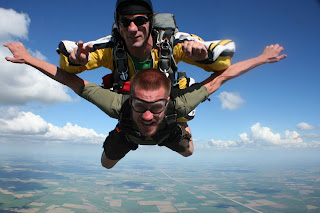
After awe inspiring beuaty of South America, endless hikes, and a thousand old churches, what can I say....
Take BA, add backpacker hostel, add bar, add ten aussies, add heat, add the festive season and you can probably guess what happened next. With special mentioned to Blue and Ryan, a seven day bender, shaming any footy trip weekend at Melbourne with a litany of steaks, brews, vino´s, music, and parties. A traditional Christmas Eve dinner of Chinese takeaway at the hostel was followed by at a dance party that started at two, got kicking at three until we left after five. The after party, starting at 8am Christmas day held captive two of our aussies mates who duly arrived for Christmas lunch around 2pm.
Joined by Johana from Finland and our aussie bretheren, we dragged ourself towards Recoletta for a hearty Christmas steak and then afternoon / evening at a chilled little wine bar.
Today a BA lite, the impressive, but slightly run down city of Rosario is a pretty city holding a smiliar population to that of home. With a cost of living a third or a half of BA, the riverside city loses only a little culture, with a cafe of every street, street vendors and buskers in the main, monuments, impressive buildings, and the first house of Che Guevara.
It´s like a hurricane. You can see it coming from a mile away, you see the storm building on the horizon, you can feel it´s breeze before it get´s there, and when it gets there, it rains down on you. It´s as simple as that.
I always knew this feeling was invetiable. The night before it was going to come. Several hours in the shade, waiting your turn you know it is just around the corner. On your way up, your thinking it should be here by now. But then, the door is opened at it is time. It grips you like it never has before, you try to conceal it with a wry smile to little effect. These guys do this and see this every day after all. This fear, this gut wrenching fear is unsurpassed as you are about, or are expected to jump 3000 metres out of a moving plane.
Thankfully, these guys are old pro´s, even if they only provided a three minute safety talk prior, after all, what can you expect for $OZ150 anyway? Asked to move my feet out the door momentarily laspses my panic, but now I am truly scared. However, my partner grinding me into position, I realise the choice to jump is now not mine. The first seconds contain only panic, the next few joy with a scream of elation, then I can relax as I´m falling screaming and shouting down to earth over the next minutes. Absolutley FANTASTIC. Before I know it, the shoot is pulled and we float and I guide our parachute over the city, with a couple of spins and turns until we land on the field about five minutes later. I must say, that much adrenaline is coursing through your veins causes the concept of time to become meaningless. I could have last one minute or ten?!?! It was fantastic, you must do it and do it soon!!!

Thursday, 20 December 2007
Cable tv, thongs, and parilla
Described as far from the world cup of tourist destinations in the lonely, we were far from disappointed or suprised by our stay in Rio Gallegos. At worst, it´s a bus stop. At best, it was a chance to sit on the bed, watch a bit of cable, and enjoy a bottle or two of vino with cheese.
Entirely beyond me are the reasons for the only flight out to Buenos Aires leaving weekly at 1:30 in the morning on a Tuesday.
After a day in Buenos, you get the impression this is a city anyone could live in. Perfect weather for t-shirts and shorts, nipped down the mall for a new pair of thongs. You pinch youself when even the bad cuts of beef are cooked with the tenderness and dedication of a $30 steak. A couple of nice regional beers to soothe the heat and decent cheap argentinian and chilean wine. The streets are home to fabulous 19th century architecure and ample shopping and markets to keep Beth happy for weeks. It´s a world away from the stunning landscape and often brutal weather of patagonia.
Entirely beyond me are the reasons for the only flight out to Buenos Aires leaving weekly at 1:30 in the morning on a Tuesday.
After a day in Buenos, you get the impression this is a city anyone could live in. Perfect weather for t-shirts and shorts, nipped down the mall for a new pair of thongs. You pinch youself when even the bad cuts of beef are cooked with the tenderness and dedication of a $30 steak. A couple of nice regional beers to soothe the heat and decent cheap argentinian and chilean wine. The streets are home to fabulous 19th century architecure and ample shopping and markets to keep Beth happy for weeks. It´s a world away from the stunning landscape and often brutal weather of patagonia.
Monday, 17 December 2007
Plastic fantastic, Belinda Carlisle, and the return of the Wayanns Brothers
Location, location, location. Fortune surely smiles of the citizens of El Calafate. Strategically located between three pristine tourist attractions, the majestic El Chalten, Torres del Paine parque nacional, and it´s own Perito Mereno, it is a major Patagonian pit stop on the gringo trail. Unfortunately, this all comes at a cost, the plastic boardwalk is surrounded by fancy restaurants, tacky and over priced souvenirs, over zealous hotelier's greeting every bus arrival, more good old fashioned southern cone price fixing, and enough gringo´s to make you vomit in your cafe prepared Cesar salad. Stay one night, see the glacier, and hit the road.
One of the few remaining advancing glaciers in this carbon addicted world, the three hour visit of ¨just¨ a simple old glaciers is sublime. The setting is both beuatiful and peaceful in los glaciers parué nacional. The sounds of the glacier cracking under the enourmous pressure of the 60km glacier and the anticipation of witnessing the crumbling and disintegration of the edge provide for a magnificent afternoon.
Perhaps the 80´s pop star playing loudly in my sister´s room was
right.... Heaven truly is a place on earth, it´s the humble country village of El Chaltén, only slightly tainted by the trail of the gringo´s. A haven for trekkers and climbers alike, the scenery is magnificent, dotted with ample glaciers, lagoons, mountains, valleys, rivers, and waterfalls. By far not a winter desination, the populations plummets by half to 800 with the threat of six hour days and endless wind, snow, and rain. The imminent paving of the road to El Calafate threatens to reduce this town into a heartless, money hungry town, reminiscent of El Calafate.
With the sun shining and the wind at a minimum, the twenty hour days were enjoyed a minute at a time. Starting with a six hour hike, our travels provided unparalleled beauty with only a trickle of tourists. A gruelling twelve hour day of hiking, ice trekking on the glacier, and climbing ice walls rewarded a unique experience and ample views. A little sympathy, home cooked pasta, and another quality bargain basement Argentinian vino went along way to recuperating those sore and tired old joints.

Finally, our trip to Rio Gallegos was greeted by the return of a Wayanns brothers on the fantastic Tasqa bus.
One of the few remaining advancing glaciers in this carbon addicted world, the three hour visit of ¨just¨ a simple old glaciers is sublime. The setting is both beuatiful and peaceful in los glaciers parué nacional. The sounds of the glacier cracking under the enourmous pressure of the 60km glacier and the anticipation of witnessing the crumbling and disintegration of the edge provide for a magnificent afternoon.
Perhaps the 80´s pop star playing loudly in my sister´s room was
right.... Heaven truly is a place on earth, it´s the humble country village of El Chaltén, only slightly tainted by the trail of the gringo´s. A haven for trekkers and climbers alike, the scenery is magnificent, dotted with ample glaciers, lagoons, mountains, valleys, rivers, and waterfalls. By far not a winter desination, the populations plummets by half to 800 with the threat of six hour days and endless wind, snow, and rain. The imminent paving of the road to El Calafate threatens to reduce this town into a heartless, money hungry town, reminiscent of El Calafate.
With the sun shining and the wind at a minimum, the twenty hour days were enjoyed a minute at a time. Starting with a six hour hike, our travels provided unparalleled beauty with only a trickle of tourists. A gruelling twelve hour day of hiking, ice trekking on the glacier, and climbing ice walls rewarded a unique experience and ample views. A little sympathy, home cooked pasta, and another quality bargain basement Argentinian vino went along way to recuperating those sore and tired old joints.

Finally, our trip to Rio Gallegos was greeted by the return of a Wayanns brothers on the fantastic Tasqa bus.
Tuesday, 11 December 2007
Glacier heaven, the mother of all assumptions, and a vampires worst nightmare
Certainly by Andian standards, the ten hour trip to Puerto Monnt was deluxe to say the least. Semi reclining seats, blankets, heating.... we almost had it all, but for a lack of a vintage van damme movie. Arriving at the small harbour city with a thriving salmon industry and the gateway to pictureque Chiloé islands one would think it´ll all be fairies and apples. However, with our wallets trembling against a resurgent Chilean economy we ate simple and small and caught the next place to Bariloche.
Now, assumption being the mother, I´d assumed that Balmaceda was simply the airpot name for Bariloche, ala Schipol or Heathrow..... How wrong one can be. Hmmm....I think I took a wrong turn at albuquerque. Anyway, picturesque as it was, Coyhaique (Blamaceda) was not Barilcohe, an hour South instead of east landed us in a backwater, and offseason at that. Flustered, cold, and in distinct need of a beer, we regrouped at a local hospedaje before booking the next flight to Punta Arenas relinquishing the fading plans that were Bariloche.
Well below Australia and South Africa, and a smidge south of New Zealand, Chile and Argentina host the beuatiful and often inhospitable land and waters of tierra del fuego and Patagonia. Vibrant fishing, petroleum, and tourism industries are the mainstays in the midst of never ending summer days and endless winter nights. Rising at 04:00 and setting at 20:30, only a devoted clubber or night worker would ever see the sun. The tempreature hovers between 10 and twenty during summer with a howling wind, contant threat of rain, hail, and even snow. On that information alone, you´d wonder why hundreds of thousands visit each summer. Well, we will start with penguins, antartica, hundred´s of thousands of untouched beuaty, 60km wide glaciers, ski, fishing, and trust me, loads and loads of hiking.
Only the third most southern city in the world, Punta Arenas lacks that killer attraction of it´s surroundings but more than survives as the major port and tourist hub for the region. Featuring a stunning colonial heart but surrounded by dull city of 100,000, the signs of affluence are appearing.
Now, these ain´t my finest hours of travel planning, but anyway, we hit the road to Puerto Natales the next day for storied Tierra del Paine parque nacional. Oh... and we did enjoy a nice but expensive dinner with stunning chilean wine, krill, lama paté, a bit of cervicher, and the pun inducing beaver ... mmmmmm
I do miss the nicities and humour of the good Andiian folk.
Housing a whole lot of tin sheds with a few nice brick buildings, Puerto Natales was not much more than supper, planning our hikes, and squelching on a few promises of business to a hostales and a tourist operator.
Never forgetting a promise, I take Beth up on three nights camping in Tierra del Paine parque nacional; Apparently the seven prior nights without electricity in the jungle and the andies were not enough. Like everything Chilean, the parque was expensive and the advice given by Path@gone was anything but handy.... Neverthless, over three days, we camped, cooked our own food, and hiked the W over sixty kilometres up two mountains, viewing several glaciers, many lakes, and some of the most stunning scenary I have ever seen. It was fantastic, but oh my god, it was tough. Day two alone involved hiking 27 kilometres in 9 hours.... After our recent travels, the timing was perfect for nature and your own thoughts.... Although I kept disturbingly getting late 80´s and early 90´s songs stuck in my head.
The Argentinin Peso, how I do love currencies pegged to the stumbing american dollar. Next stop, El Calafate.
Now, assumption being the mother, I´d assumed that Balmaceda was simply the airpot name for Bariloche, ala Schipol or Heathrow..... How wrong one can be. Hmmm....I think I took a wrong turn at albuquerque. Anyway, picturesque as it was, Coyhaique (Blamaceda) was not Barilcohe, an hour South instead of east landed us in a backwater, and offseason at that. Flustered, cold, and in distinct need of a beer, we regrouped at a local hospedaje before booking the next flight to Punta Arenas relinquishing the fading plans that were Bariloche.
Well below Australia and South Africa, and a smidge south of New Zealand, Chile and Argentina host the beuatiful and often inhospitable land and waters of tierra del fuego and Patagonia. Vibrant fishing, petroleum, and tourism industries are the mainstays in the midst of never ending summer days and endless winter nights. Rising at 04:00 and setting at 20:30, only a devoted clubber or night worker would ever see the sun. The tempreature hovers between 10 and twenty during summer with a howling wind, contant threat of rain, hail, and even snow. On that information alone, you´d wonder why hundreds of thousands visit each summer. Well, we will start with penguins, antartica, hundred´s of thousands of untouched beuaty, 60km wide glaciers, ski, fishing, and trust me, loads and loads of hiking.
Only the third most southern city in the world, Punta Arenas lacks that killer attraction of it´s surroundings but more than survives as the major port and tourist hub for the region. Featuring a stunning colonial heart but surrounded by dull city of 100,000, the signs of affluence are appearing.
Now, these ain´t my finest hours of travel planning, but anyway, we hit the road to Puerto Natales the next day for storied Tierra del Paine parque nacional. Oh... and we did enjoy a nice but expensive dinner with stunning chilean wine, krill, lama paté, a bit of cervicher, and the pun inducing beaver ... mmmmmm
I do miss the nicities and humour of the good Andiian folk.
Housing a whole lot of tin sheds with a few nice brick buildings, Puerto Natales was not much more than supper, planning our hikes, and squelching on a few promises of business to a hostales and a tourist operator.
Never forgetting a promise, I take Beth up on three nights camping in Tierra del Paine parque nacional; Apparently the seven prior nights without electricity in the jungle and the andies were not enough. Like everything Chilean, the parque was expensive and the advice given by Path@gone was anything but handy.... Neverthless, over three days, we camped, cooked our own food, and hiked the W over sixty kilometres up two mountains, viewing several glaciers, many lakes, and some of the most stunning scenary I have ever seen. It was fantastic, but oh my god, it was tough. Day two alone involved hiking 27 kilometres in 9 hours.... After our recent travels, the timing was perfect for nature and your own thoughts.... Although I kept disturbingly getting late 80´s and early 90´s songs stuck in my head.
The Argentinin Peso, how I do love currencies pegged to the stumbing american dollar. Next stop, El Calafate.
Monday, 3 December 2007
The last of La Paz, a two buck fitty haircut, and a dodgy vindaloo
Our last days in La Paz succumbed to the temptations of cheap touristy travel in one of the world´s cheapest destinations...... Artesenal shopping galore, continental delicacies, and a hotel room with cable TV and an en-suite. Street vendors offer their wares at any time and any place, rarely defined by the boundaries of a market.... Prices are so cheap, you barely raise a sweat in only knocking them down a dollar of the miniscule price. Genuine FC Barelonca for $15 with a fake made to custom fit for $5. A finally, a hair cut to match my father´s for world cheapest due..... $2.50 numero dos para todo de mi cabeza

After the Chilean economic miracle, Santiago can truly combine the bueatyh of rich colonial past with a modern city of subways, sky scrapers, and a standard of living unsurpassed in South America. Unfortunately, that´s all I can say, as after a particularly hard night on the turps and a bought food poisoning, little experience or knowledge was garnered.... luckily, we´ll be back in a month.

After the Chilean economic miracle, Santiago can truly combine the bueatyh of rich colonial past with a modern city of subways, sky scrapers, and a standard of living unsurpassed in South America. Unfortunately, that´s all I can say, as after a particularly hard night on the turps and a bought food poisoning, little experience or knowledge was garnered.... luckily, we´ll be back in a month.
Thursday, 29 November 2007
Tiahuanaco, Coca, the world´s most dangerous road, and what do you mean our tickets are cancelled
Passing through the urban sprawl become city el alto, we overlook the remarkable valley and city of La Paz. The border of snow capped mountains deliver an unparalled background and the world highest ski slopes. Breathtakingly 3,600 above sea, all foot travels suffer the effects of the altitude; where suicide is the term used by visiting football teams and lethargy and shortness of breath are common. Catering for between 1.6 and 1.8 million inhabitants it holds the power and privelledge of Bolivia, if not the official capital status. Incomparable to Lima or Quito where style, grace, and culture is interwined between poverty, street sellers, and open sewers. By far the cheapest destination thus far, a superb lunch for two with drinks is $5 unless you roll the dice on a friendly street vendor.
A trip to La Paz is not complete without a visit to the coca museum. Used by pre-columbian civilisations to adjust to altitude, reduce hunger, physcial increase output and as a basic anaesthetic, it was declared a path to the devil and banned by the church. After discovering it´s properties the colonial goveners overturned the ban and made it´s used by indigenous slaves mandatory in the mines to foster ¨shifts¨of up to 48 hours. At one point, it´s per kilo value was greater than gold. Avoiding the known history of the drug wars of the 20th century, Bolivia today legally produces coca for traditional uses, although much is diverted to neighboring countries for the production of cocaine. Interestingly, Bolivia is not one of the roughly a dozen western countries that can legally produce cocaine.... Also coke still uses coca leaves for flavour.
A visit to the pre-incan ruins of Tiahuanaco produced a tour guide garnering conjecture as fact and a site that after restoration may one day rivial Machu Pichu.
Reviewing the logistics of our impending travel, we head down to the local LAN office to book an early flight to Santiago. Much to our suprise, the officer, who we´ll call Juanita, informs that all of our forwarding tickets have been cancelled due Iberia, which we already loathed, incorrectly altering our flight changes we requested in Spain..... dumbasses... Our shock compounded by the knowledge that all of our future flights were fully boooked raised the old blood pressure just a tad. Luckilly, Juanita was up to the challenge with a wink and a nod a quick phone call secured our passage on the aforementioned flights.
It´s a wonder what boredom can ¨force¨ you to do. After daily knockbacks for an early flight and ingorning some fatherly advice, I booked passage by mountain bike on the Coroico road. In 1995, the Inter-American Development Bank dubbed the road ¨the worlds most dangerous¨ where a fatal accident is not uncommon every fortnight ... Starting early and high in the Bolivian Andes with white knuckles from the cold and a hearty grip of the handle bars, we embarked down a 64 kilometre, single lane, mountain hugging, waterfall disecting dirt and stone laden road descending 3,600 to the warmth of the sub tropics. One thing is certain, the fantastic setting would have been much greatly appreciated if my knuckles were not so sore two days later.

A trip to La Paz is not complete without a visit to the coca museum. Used by pre-columbian civilisations to adjust to altitude, reduce hunger, physcial increase output and as a basic anaesthetic, it was declared a path to the devil and banned by the church. After discovering it´s properties the colonial goveners overturned the ban and made it´s used by indigenous slaves mandatory in the mines to foster ¨shifts¨of up to 48 hours. At one point, it´s per kilo value was greater than gold. Avoiding the known history of the drug wars of the 20th century, Bolivia today legally produces coca for traditional uses, although much is diverted to neighboring countries for the production of cocaine. Interestingly, Bolivia is not one of the roughly a dozen western countries that can legally produce cocaine.... Also coke still uses coca leaves for flavour.
A visit to the pre-incan ruins of Tiahuanaco produced a tour guide garnering conjecture as fact and a site that after restoration may one day rivial Machu Pichu.
Reviewing the logistics of our impending travel, we head down to the local LAN office to book an early flight to Santiago. Much to our suprise, the officer, who we´ll call Juanita, informs that all of our forwarding tickets have been cancelled due Iberia, which we already loathed, incorrectly altering our flight changes we requested in Spain..... dumbasses... Our shock compounded by the knowledge that all of our future flights were fully boooked raised the old blood pressure just a tad. Luckilly, Juanita was up to the challenge with a wink and a nod a quick phone call secured our passage on the aforementioned flights.
It´s a wonder what boredom can ¨force¨ you to do. After daily knockbacks for an early flight and ingorning some fatherly advice, I booked passage by mountain bike on the Coroico road. In 1995, the Inter-American Development Bank dubbed the road ¨the worlds most dangerous¨ where a fatal accident is not uncommon every fortnight ... Starting early and high in the Bolivian Andes with white knuckles from the cold and a hearty grip of the handle bars, we embarked down a 64 kilometre, single lane, mountain hugging, waterfall disecting dirt and stone laden road descending 3,600 to the warmth of the sub tropics. One thing is certain, the fantastic setting would have been much greatly appreciated if my knuckles were not so sore two days later.

Saturday, 24 November 2007
Cusco, Puno, and Lake Titicaca
After recovering from the hike and the odd celebratory drink in cusco for a day we hit the road for Puno and Lake Titicaca on a tourist bus ....... Local bus six hours, tourist bus nine with plenty of gringo stops and not even a 1980´s van Damme flick to pass the time. Worst bus ride ever!!!. At our designated feed trough, you were even charged for $1 for milk with coffee.
Our main purpose to utilise the harbour of Titicaca severly limited our exposure to the small city of Puno. A couple of gringo restaurants, bycicle taxi´s.... and oh yeah, Beth seems to think I am responsible for hangovers of the tour guide and a fellow travellor´s ?!?!?!?
Straddling Peru and Boliva 3,812m above sea level, Lake Titicaca is the largest lake above 3,000 metres covering 8,372 km². With two distinct ethnic groups, Quecha and Amayra, with multiple cultures over the 42+ islands, it has much to offer. Attracted in part by the name and the famed Uros people who reside in floating islands constructed with reeds, we departed on a overnight trip to visit several islands and a homestay.
Our first stop on Taquile and the last on one of the Uros Islands, although touristy and annoyingly so on the latter, still presented interseting insights into their cultures. The men of Quechan Taquile both farm and knit with all dressing according to their social position and marital status. Initially constructed to flee the constant fighting on the mainland, the Uros islands hold over 3000 Aymara on over 41 floating reed islands forming the Uros Islands. Each housing up to 10 families on each.
But not all was lost.... We arrived at Amantaní island for the homestay with expectations of a slice of local life, a family without English or Spanish, and a game of football (soccer). Disembarking, we ascended another 300 metres with Olga, the hostess with the mostess, welcoming us into her two story mudbrick home with introductions to her family of five. Fortunatly, Spanish was known and we conversed on the favourites.... Football, Kangaroo´s, the weather, and work. Misinterpriting Olga´s after dinner request to change in our party clothes, we headed up stairs and waited for her to escort us to the fiesta. I´ll let the picture tell the story of what she actually said.

Cerveza´s, music, dancing with our hosts to fifteen minute songs were the theme of the fiesta and all who partook enjoyed a memorably experience.
Random Thoughts
= I´ve had ¨Copa Copacabana¨ stuck my head for the past week, as the famed city, which is neither north or hotter than habana, inhabit the shores.
= Bolivia maintain an active Navy in Lake Titicaca despite it´s landlocked status.
= Residents of the Lake pay no taxes leaving one to suspect the government wants to retain the locals as the tourist attraction removing any reasons for economic migration.
= A few games of football were enjoyed on Amantani, which at the altitude, is not easy. Holding up the defense whilst my Spanish and Scottish team mates scored goal after goal the competition was flattened.
Our main purpose to utilise the harbour of Titicaca severly limited our exposure to the small city of Puno. A couple of gringo restaurants, bycicle taxi´s.... and oh yeah, Beth seems to think I am responsible for hangovers of the tour guide and a fellow travellor´s ?!?!?!?
Straddling Peru and Boliva 3,812m above sea level, Lake Titicaca is the largest lake above 3,000 metres covering 8,372 km². With two distinct ethnic groups, Quecha and Amayra, with multiple cultures over the 42+ islands, it has much to offer. Attracted in part by the name and the famed Uros people who reside in floating islands constructed with reeds, we departed on a overnight trip to visit several islands and a homestay.
Our first stop on Taquile and the last on one of the Uros Islands, although touristy and annoyingly so on the latter, still presented interseting insights into their cultures. The men of Quechan Taquile both farm and knit with all dressing according to their social position and marital status. Initially constructed to flee the constant fighting on the mainland, the Uros islands hold over 3000 Aymara on over 41 floating reed islands forming the Uros Islands. Each housing up to 10 families on each.
But not all was lost.... We arrived at Amantaní island for the homestay with expectations of a slice of local life, a family without English or Spanish, and a game of football (soccer). Disembarking, we ascended another 300 metres with Olga, the hostess with the mostess, welcoming us into her two story mudbrick home with introductions to her family of five. Fortunatly, Spanish was known and we conversed on the favourites.... Football, Kangaroo´s, the weather, and work. Misinterpriting Olga´s after dinner request to change in our party clothes, we headed up stairs and waited for her to escort us to the fiesta. I´ll let the picture tell the story of what she actually said.

Cerveza´s, music, dancing with our hosts to fifteen minute songs were the theme of the fiesta and all who partook enjoyed a memorably experience.
Random Thoughts
= I´ve had ¨Copa Copacabana¨ stuck my head for the past week, as the famed city, which is neither north or hotter than habana, inhabit the shores.
= Bolivia maintain an active Navy in Lake Titicaca despite it´s landlocked status.
= Residents of the Lake pay no taxes leaving one to suspect the government wants to retain the locals as the tourist attraction removing any reasons for economic migration.
= A few games of football were enjoyed on Amantani, which at the altitude, is not easy. Holding up the defense whilst my Spanish and Scottish team mates scored goal after goal the competition was flattened.
Wednesday, 21 November 2007
Machu Pichu
During the height of the Incan Empire, Machu Pichu was constructed in 1450, as one theory holds, as a city of religious importance. After three years of brutal Spanish rule, the puppet king, Manco Inca strategically fled Cusco for Vilcabamba bypassing and essentially hiding the nearby Machu Pichu, which was only 30 kms away. Even after the last Inca (king) was drawn and quarted or strangled, the whereabouts of the city where never revealed. It is thought the 1000 inhabitants fled to assist the assults of the Spanish. It was only in the early 20th century, it was rediscovered under the forests by workers of the railways who pillages the vast silver and gold, and notably by the Hiram Bingam in 1912, who pillaged over 3000 artifacts for private and public museums in the states.
Built with all the beuaty of remaining Inca sites, walls and terraces are constructed through hand polishing original mountain rocks and stones without mortar, but so precise that sunlight can not penetrate even the joins of a gardeners house.
Each morning, the sun gate shines sunlight through a window of the Temple of the sun, which at one point, illuminated a sacred object. Massive terraces produced coca, potatoes, maize, and orchids with Soil brought from a 1000 metres below. An impressive sundial directly between Machu Pichu and Wiynam Pichu mountains marks the equinox.

After one of only a few hundred who reach the site by hiking each day, it is easy to feel a sense of ownership when surrounded by the hoards of tourists who arrive by train or bus each day and only grasp a fraction of the story. Although we are by are wide and far not experts, if you do come, ensure you hike one of the many Incan trails.
It is apparent that for reasons of ignorance and racism, most students educated in areas with small indigenous populations have little or no knowledge of the Inca´s or Machu Pichu.
Built with all the beuaty of remaining Inca sites, walls and terraces are constructed through hand polishing original mountain rocks and stones without mortar, but so precise that sunlight can not penetrate even the joins of a gardeners house.
Each morning, the sun gate shines sunlight through a window of the Temple of the sun, which at one point, illuminated a sacred object. Massive terraces produced coca, potatoes, maize, and orchids with Soil brought from a 1000 metres below. An impressive sundial directly between Machu Pichu and Wiynam Pichu mountains marks the equinox.

After one of only a few hundred who reach the site by hiking each day, it is easy to feel a sense of ownership when surrounded by the hoards of tourists who arrive by train or bus each day and only grasp a fraction of the story. Although we are by are wide and far not experts, if you do come, ensure you hike one of the many Incan trails.
It is apparent that for reasons of ignorance and racism, most students educated in areas with small indigenous populations have little or no knowledge of the Inca´s or Machu Pichu.
Subscribe to:
Posts (Atom)

